
Introduction
Cybersecurity threats have become more frequent, complex, and costly for businesses and individuals alike. From phishing emails and ransomware attacks to data breaches and account takeovers, cybercriminals are constantly finding new ways to exploit weaknesses in digital systems.
FOR MORE SOLUTIONS VISIT
Traditional security tools are still important, but they often struggle to keep up with modern threats that evolve quickly. Security teams can be overwhelmed by thousands of alerts every day, making it difficult to identify genuine risks in time.
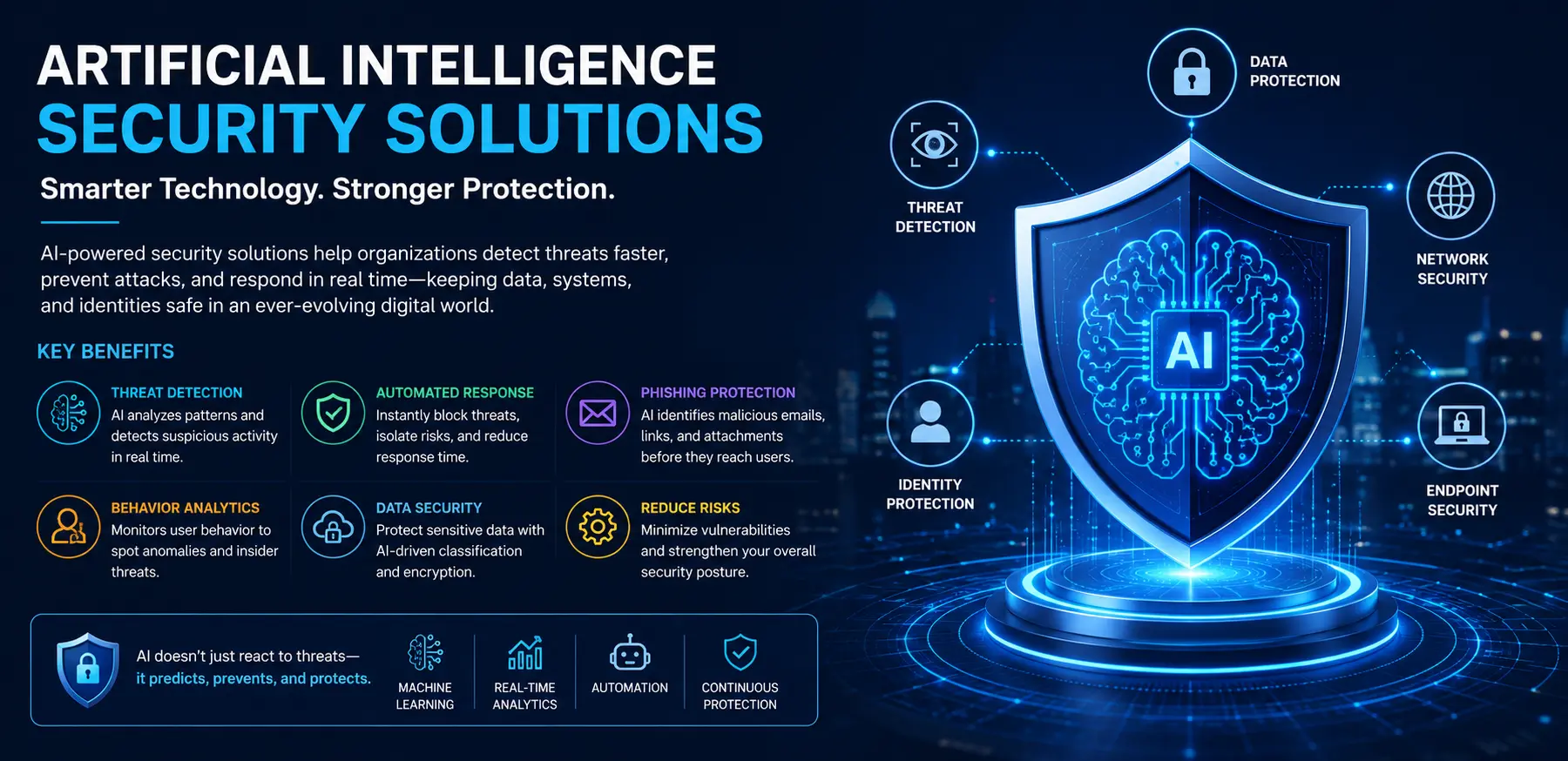
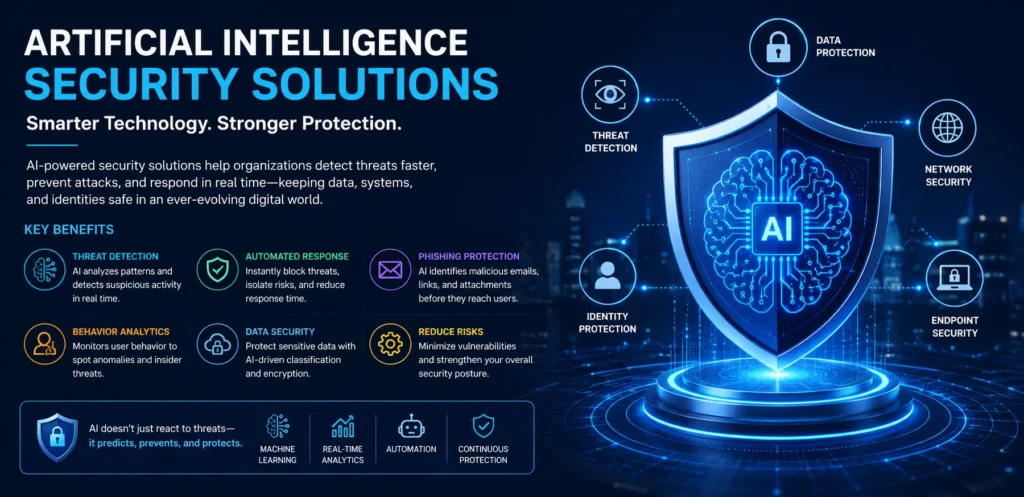
This is where Artificial Intelligence Security Solutions are making a significant difference. By analyzing large amounts of data, identifying unusual behavior, and automating responses, AI-powered security systems help organizations detect and stop threats faster than traditional methods alone.
This guide explains the challenges organizations face, the causes behind security vulnerabilities, and how artificial intelligence can provide practical solutions.
Main Causes of Modern Cybersecurity Problems
Understanding the root causes of cybersecurity issues helps explain why AI-based security tools have become so valuable.
1. Growing Volume of Cyber Threats
Businesses generate enormous amounts of digital data every day. At the same time, cybercriminals launch millions of attacks targeting networks, websites, and user accounts.
Human security teams cannot manually review every event or alert, which increases the chance of missing dangerous activity.
2. Sophisticated Attack Techniques
Attackers now use advanced methods such as:
- Phishing campaigns
- Ransomware attacks
- Credential theft
- Zero-day exploits
- Social engineering scams
These attacks often appear legitimate, making them difficult for traditional security systems to identify.
3. Human Error
Many security incidents occur because of simple mistakes, including:
- Weak passwords
- Clicking malicious links
- Misconfigured systems
- Sharing sensitive information
Even well-trained employees can make errors that expose organizations to risk.
4. Limited Security Resources
Small and medium-sized businesses often lack dedicated cybersecurity teams. Security professionals are in high demand, making it difficult for many organizations to monitor threats around the clock.
5. Increasing Digital Dependence
Cloud services, remote work, mobile devices, and connected systems have expanded the number of potential entry points for attackers. Every new digital tool creates additional security responsibilities.
Step-by-Step Solutions Using Artificial Intelligence Security Solutions
AI-powered security platforms help organizations overcome many of these challenges. Here are practical ways they can be implemented.
Step 1: Deploy AI-Powered Threat Detection
The first step is using AI systems that continuously monitor networks, devices, and applications.
These tools can:
- Analyze user activity
- Monitor network traffic
- Identify suspicious patterns
- Detect unusual behavior
For example, if an employee suddenly downloads large amounts of sensitive data at an unusual hour, the AI system can flag the activity for investigation.
Step 2: Implement Automated Malware Detection
Traditional antivirus software often relies on known threat signatures. AI-based solutions go beyond this by analyzing behavior.
AI can detect:
- Unknown malware
- Fileless attacks
- Ransomware activity
- Suspicious application behavior
This allows organizations to stop threats before significant damage occurs.
Step 3: Strengthen Email Security
Email remains one of the most common attack methods.
AI-driven email protection systems can:
- Detect phishing attempts
- Analyze suspicious attachments
- Evaluate sender behavior
- Identify fraudulent domains
These systems reduce the risk of employees falling victim to malicious emails.
Step 4: Use Behavioral Analytics
Artificial intelligence can learn normal behavior patterns for users and devices.
Once a baseline is established, the system can identify abnormalities such as:
- Unusual login locations
- Multiple failed login attempts
- Unexpected data transfers
- Access to restricted resources
Behavioral analytics often detects threats that traditional security rules miss.
Step 5: Automate Incident Response
Speed matters during a cyberattack.
Modern AI security platforms can automatically:
- Block malicious IP addresses
- Isolate infected devices
- Disable compromised accounts
- Trigger security alerts
Automation reduces response times and limits the impact of attacks.
Step 6: Continuously Monitor Security Risks
AI systems operate continuously without fatigue.
They can:
- Monitor cloud environments
- Track endpoint devices
- Analyze application activity
- Identify emerging threats
Continuous monitoring helps organizations stay ahead of attackers.
Advanced Fixes for Stronger Security
While basic AI implementation provides significant benefits, organizations can achieve even better protection through advanced strategies.
Predictive Threat Intelligence
AI can analyze historical attack data and identify patterns associated with future threats.
This enables organizations to:
- Anticipate attack trends
- Prioritize vulnerabilities
- Improve security planning
Predictive analysis allows security teams to become proactive rather than reactive.
AI-Powered User and Entity Behavior Analytics (UEBA)
UEBA solutions examine behavior across users, devices, and systems.
These tools are particularly effective at identifying:
- Insider threats
- Compromised accounts
- Unauthorized access attempts
- Privilege abuse
Because they focus on behavior rather than signatures, they can detect subtle threats that might otherwise remain hidden.
Security Orchestration and Automation
Security orchestration platforms integrate multiple tools into a unified system.
AI can automate complex workflows such as:
- Detecting a threat
- Collecting evidence
- Prioritizing severity
- Launching response actions
- Creating incident reports
This reduces workload for security teams while improving response efficiency.
AI-Based Vulnerability Management
Organizations often struggle to prioritize thousands of vulnerabilities.
AI-driven vulnerability management tools can:
- Rank risks by severity
- Identify likely attack paths
- Recommend remediation actions
- Reduce unnecessary patching efforts
This ensures critical issues receive immediate attention.
Deep Learning for Threat Detection
Deep learning models can identify complex relationships within security data.
Applications include:
- Fraud detection
- Advanced malware analysis
- Network anomaly detection
- Identity verification
These models continuously improve as they process more data.
Tips to Prevent Security Issues in the Future
Artificial intelligence is powerful, but it works best alongside strong security practices.
Use Strong Authentication
Implement:
- Multi-factor authentication (MFA)
- Strong password policies
- Password managers
This reduces the risk of unauthorized access.
Keep Software Updated
Regular updates help close security gaps before attackers can exploit them.
Update:
- Operating systems
- Applications
- Browsers
- Security tools
Train Employees Regularly
Security awareness training should cover:
- Phishing detection
- Password security
- Safe browsing habits
- Data protection practices
Educated users remain one of the strongest security defenses.
Back Up Critical Data
Maintain secure backups and test restoration procedures regularly.
Backups help organizations recover quickly from ransomware and accidental data loss.
Monitor Access Privileges
Grant users only the permissions they need.
Regularly review access rights and remove unnecessary privileges to reduce risk.
Combine AI with Human Expertise
Artificial intelligence improves security, but human oversight remains essential.
Security professionals should review alerts, investigate incidents, and make strategic decisions based on AI-generated insights.
FAQs
What are Artificial Intelligence Security Solutions?
Artificial Intelligence Security Solutions are cybersecurity tools that use AI and machine learning to detect threats, analyze behavior, automate responses, and improve overall security operations.
Can AI completely replace cybersecurity professionals?
No. AI helps automate routine tasks and improve threat detection, but human experts are still needed for decision-making, investigations, and security strategy development.
Are AI security solutions suitable for small businesses?
Yes. Many modern AI-powered security platforms are designed for businesses of all sizes. Small businesses can benefit from improved threat detection without needing large security teams.
How does AI detect cyber threats?
AI analyzes large amounts of data, learns normal patterns, and identifies unusual activity that may indicate malicious behavior. This allows threats to be detected earlier than with traditional methods.
What are the main benefits of AI in cybersecurity?
Key benefits include:
- Faster threat detection
- Automated response actions
- Reduced workload for security teams
- Improved accuracy
- Better protection against evolving threats
Conclusion
Cyber threats continue to grow in both volume and sophistication, making traditional security approaches increasingly difficult to manage on their own. Artificial Intelligence Security Solutions provide a practical way to strengthen defenses by detecting threats faster, automating security processes, and improving visibility across digital environments.
Organizations that combine AI-powered security tools with strong cybersecurity practices, employee training, and expert oversight can significantly reduce their risk exposure. As cyber threats continue to evolve, AI will play an increasingly important role in helping businesses and individuals protect their data, systems, and digital assetss
- AI Powered Cyber Defense How Artificial Intelligence Strengthens Modern Cybersecurity
- Machine Learning in Cybersecurity How Intelligent Systems Help Detect and Prevent Cyber Threats
- AI in Cybersecurity How Artificial Intelligence Is Transforming Digital Security
- AI Threat Detection How Artificial Intelligence Helps Stop Cyber Threats Before They Cause Damage
- Artificial Intelligence Security Solutions A Practical Guide to Smarter Cyber Protection
