
Introduction
Cybersecurity threats are becoming more advanced every year. Businesses, governments, and individuals face constant risks from phishing attacks, ransomware, malware, account takeovers, and data breaches. Traditional security tools can still provide valuable protection, but many struggle to keep up with rapidly changing attack methods.
FOR MORE SOLUTIONS VISIT
Security teams often deal with thousands of alerts daily, making it difficult to identify genuine threats quickly. Attackers also use automation to launch large-scale campaigns that can overwhelm conventional security systems.
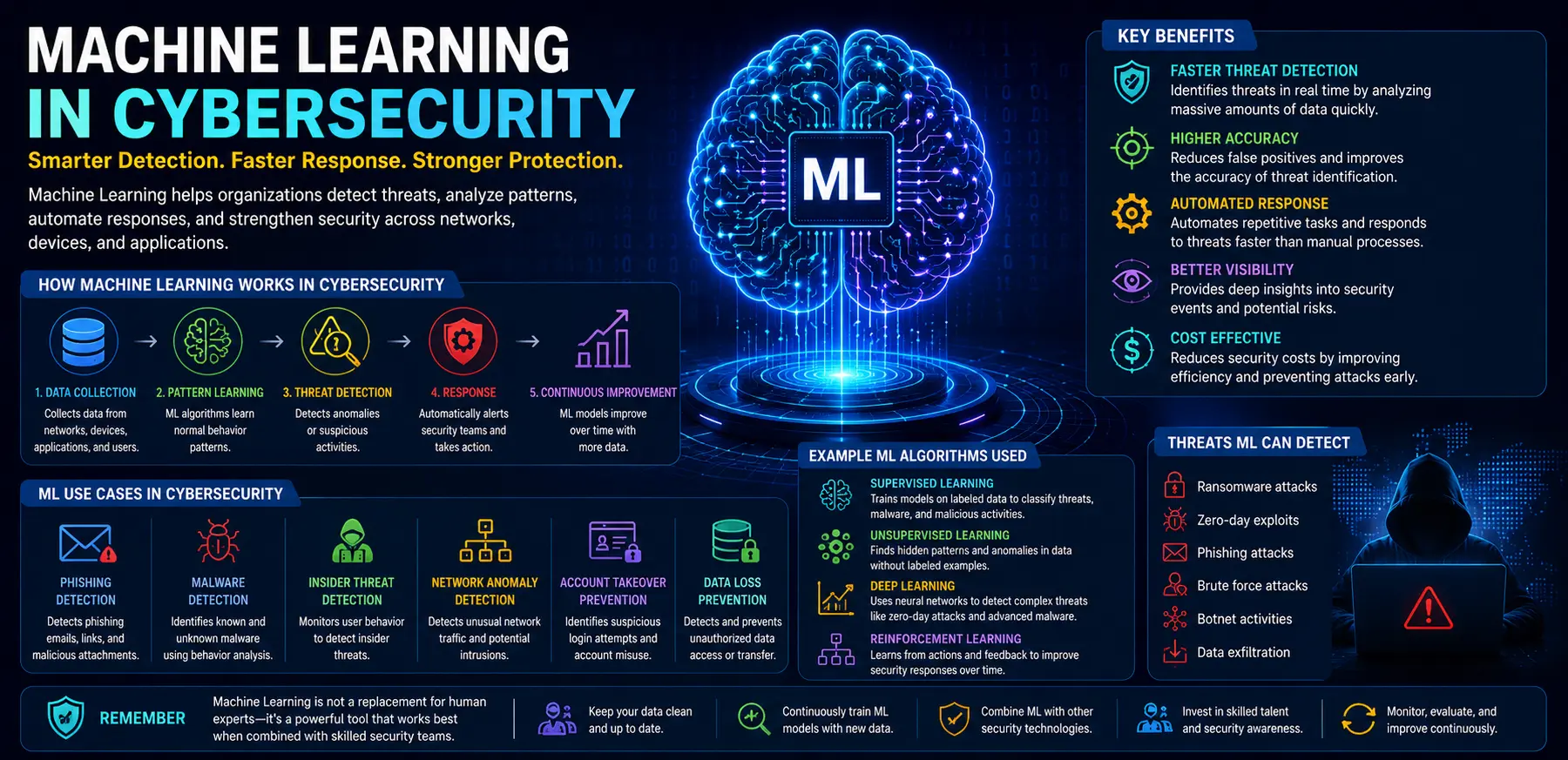
This challenge has led to the growing adoption of Machine Learning in Cybersecurity. Machine learning allows security systems to analyze huge amounts of data, identify suspicious patterns, and detect threats that may otherwise go unnoticed. Unlike traditional systems that rely heavily on predefined rules, machine learning can learn from data and improve its detection capabilities over time.
Understanding how machine learning works in cybersecurity can help organizations strengthen their defenses, reduce risks, and respond more effectively to modern cyber threats.
Main Causes of Cybersecurity Challenges
Several factors contribute to the growing complexity of cybersecurity.
1. Increasing Volume of Cyber Attacks
Cybercriminals launch millions of attacks every day. These attacks target:
- Business networks
- Cloud environments
- Mobile devices
- Personal accounts
- Online services
The sheer number of threats makes manual monitoring difficult.
2. Rapidly Evolving Threats
Attackers continuously modify malware, phishing techniques, and hacking tools to avoid detection.
Traditional security systems that rely on known signatures may struggle to identify new attack variations.
3. Human Error
Many security incidents occur because of simple mistakes.
Examples include:
- Clicking malicious links
- Reusing passwords
- Misconfiguring systems
- Downloading unsafe files
Human error remains one of the most common causes of security breaches.
4. Massive Data Generation
Organizations generate enormous amounts of security-related data through:
- User activity logs
- Network traffic
- Applications
- Cloud services
- Connected devices
Analyzing this information manually is often impossible.
5. Limited Security Resources
Many organizations face a shortage of cybersecurity professionals.
Smaller businesses especially may lack the personnel needed to monitor threats continuously.
Step-by-Step Solutions Using Machine Learning in Cybersecurity
Machine learning provides practical ways to improve cybersecurity operations and reduce risk.
Step 1: Collect Security Data
Machine learning systems depend on quality data.
Organizations should gather information from:
- Firewalls
- Endpoint devices
- Servers
- Cloud platforms
- User activity logs
The more relevant data available, the more accurate the machine learning models become.
Step 2: Establish Normal Behavior Patterns
Machine learning algorithms first learn what normal activity looks like.
This includes:
- Typical login times
- Common user actions
- Normal network traffic
- Standard application behavior
By understanding normal behavior, the system can identify unusual activity more effectively.
Step 3: Detect Anomalies Automatically
Once baseline behavior is established, machine learning can identify anomalies.
Examples include:
- Logins from unusual locations
- Large data transfers
- Unexpected account activity
- Suspicious network connections
These anomalies often indicate potential security threats.
Step 4: Improve Malware Detection
Machine learning helps detect malware by analyzing behavior rather than relying only on signatures.
This allows organizations to identify:
- Unknown malware
- Zero-day attacks
- Fileless malware
- Ransomware activity
Behavior-based analysis significantly improves detection rates.
Step 5: Prioritize Security Alerts
Security teams often receive more alerts than they can realistically investigate.
Machine learning helps by:
- Ranking alerts by risk level
- Reducing false positives
- Highlighting critical threats
- Improving analyst efficiency
This enables faster response to genuine incidents.
Step 6: Automate Threat Response
Many machine learning security platforms support automated responses.
Actions may include:
- Blocking malicious IP addresses
- Isolating infected devices
- Restricting suspicious accounts
- Triggering security investigations
Automation reduces response times and minimizes damage.
Advanced Fixes for Stronger Cybersecurity
Organizations seeking enhanced protection can implement more advanced machine learning techniques.
User and Entity Behavior Analytics (UEBA)
UEBA uses machine learning to monitor user and device behavior continuously.
The system can detect:
- Insider threats
- Account compromise
- Privilege misuse
- Unauthorized access
Because it focuses on behavior, UEBA often detects threats that traditional tools miss.
Predictive Threat Intelligence
Machine learning can analyze historical attack data and identify patterns associated with future threats.
Benefits include:
- Better risk forecasting
- Proactive security planning
- Improved vulnerability prioritization
- Faster threat preparation
Predictive intelligence helps organizations stay ahead of attackers.
Deep Learning Models
Deep learning is a specialized branch of machine learning capable of processing complex datasets.
Cybersecurity applications include:
- Advanced malware analysis
- Fraud detection
- Threat classification
- Identity verification
Deep learning models become more effective as they process additional data.
Network Traffic Analysis
Machine learning can continuously analyze network traffic to identify suspicious behavior.
This helps detect:
- Command-and-control communications
- Data exfiltration attempts
- Unauthorized connections
- Network intrusions
Continuous monitoring improves visibility across the network.
Security Orchestration and Automation
Machine learning can integrate with automated security workflows.
The process may include:
- Detecting suspicious activity
- Gathering evidence
- Evaluating risk levels
- Launching response actions
- Generating incident reports
This reduces manual workload while improving response efficiency.
Tips to Prevent Cybersecurity Issues
Machine learning works best when combined with strong security practices.
Enable Multi-Factor Authentication
Multi-factor authentication adds an additional layer of security beyond passwords.
Even if credentials are stolen, attackers may still be unable to access accounts.
Keep Software Updated
Outdated software often contains vulnerabilities.
Regularly update:
- Operating systems
- Applications
- Browsers
- Security tools
Timely updates help prevent exploitation.
Train Employees on Security Awareness
Employees should understand how to recognize:
- Phishing emails
- Social engineering attempts
- Suspicious websites
- Unsafe downloads
Security awareness training can significantly reduce risk.
Apply the Principle of Least Privilege
Users should only have access to the resources necessary for their roles.
Limiting permissions reduces potential damage if an account becomes compromised.
Perform Regular Security Assessments
Routine security reviews help identify weaknesses before attackers do.
Assessments should evaluate:
- Network security
- Access controls
- Vulnerability management
- Incident response plans
Maintain Secure Data Backups
Regular backups help organizations recover from ransomware attacks and accidental data loss.
Backups should be:
- Encrypted
- Tested regularly
- Stored securely
Reliable backups improve business continuity.
FAQs
What is Machine Learning in Cybersecurity?
Machine Learning in Cybersecurity refers to the use of algorithms that learn from data to detect threats, identify unusual behavior, automate security tasks, and improve threat detection accuracy over time.
How does machine learning improve cybersecurity?
Machine learning analyzes large amounts of security data, identifies patterns, detects anomalies, reduces false positives, and helps security teams respond to threats more efficiently.
Can machine learning detect new cyber threats?
Yes. Unlike traditional systems that depend on known signatures, machine learning can identify suspicious behavior and previously unseen attack patterns.
Is machine learning suitable for small businesses?
Yes. Many cybersecurity providers offer machine learning-powered solutions that are affordable and scalable for small and medium-sized businesses.
What are the benefits of machine learning in cybersecurity?
Major benefits include:
- Faster threat detection
- Improved accuracy
- Reduced false positives
- Automated response capabilities
- Better protection against emerging threats
Conclusion
The growing complexity of cyber threats requires smarter and more adaptive security solutions. Machine Learning in Cybersecurity helps organizations detect suspicious activity, identify emerging threats, automate responses, and improve overall security performance.
By combining machine learning with strong cybersecurity practices, employee training, regular system updates, and expert oversight, organizations can build a more resilient defense against modern cyberattacks. As cyber threats continue to evolve, machine learning will remain one of the most valuable tools for protecting digital systems, sensitive data, and business operations.
- AI Powered Cyber Defense How Artificial Intelligence Strengthens Modern Cybersecurity
- Machine Learning in Cybersecurity How Intelligent Systems Help Detect and Prevent Cyber Threats
- AI in Cybersecurity How Artificial Intelligence Is Transforming Digital Security
- AI Threat Detection How Artificial Intelligence Helps Stop Cyber Threats Before They Cause Damage
- Artificial Intelligence Security Solutions A Practical Guide to Smarter Cyber Protection
