
Introduction
Cyber threats have become more sophisticated, frequent, and damaging than ever before. Businesses, government agencies, and individuals face constant risks from ransomware, phishing scams, malware infections, data breaches, and account takeovers. As organizations rely more heavily on digital systems, the potential impact of a successful cyberattack continues to grow.
FOR MORE SOLUTIONS VISIT
Traditional cybersecurity tools remain important, but many struggle to keep pace with modern attack methods. Security teams often face thousands of alerts every day, making it difficult to identify genuine threats quickly. Attackers can also automate their operations, allowing them to target large numbers of systems simultaneously.
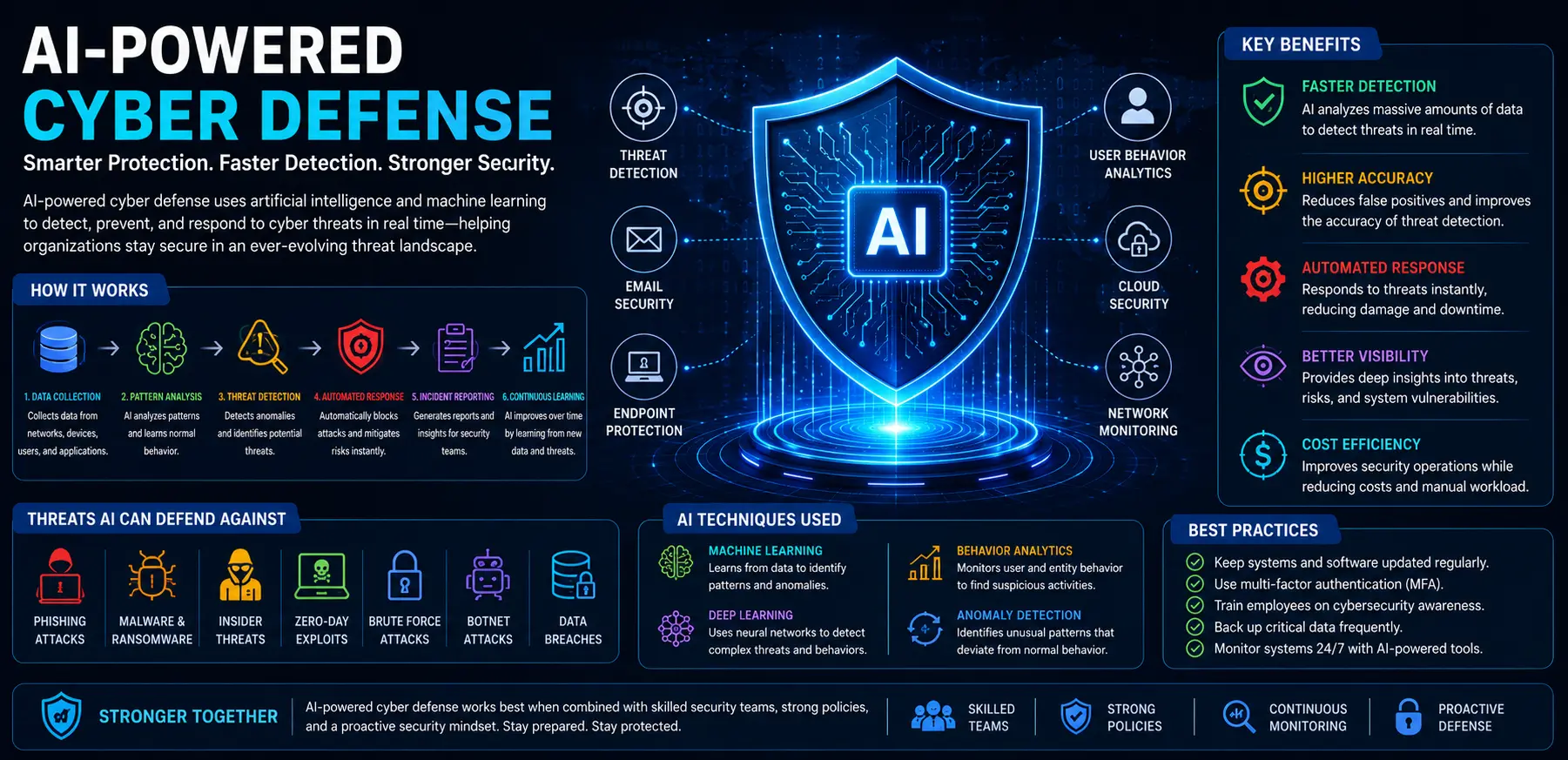
This challenge has led to the rise of AI-Powered Cyber Defense, which combines artificial intelligence, machine learning, and automation to improve threat detection, incident response, and overall security operations. AI-powered systems can analyze massive amounts of data, recognize unusual behavior, and react to threats much faster than manual processes alone.
Understanding how AI-powered cyber defense works can help organizations build stronger protection against evolving cyber risks while improving efficiency and reducing security gaps.
Main Causes of Cybersecurity Challenges
Several factors contribute to the growing need for advanced cybersecurity solutions.
1. Increasing Complexity of Cyber Attacks
Cybercriminals constantly develop new techniques to bypass traditional defenses.
Common threats include:
- Phishing attacks
- Ransomware
- Malware infections
- Credential theft
- Network intrusions
These attacks often evolve faster than traditional security systems can adapt.
2. Massive Volumes of Security Data
Organizations generate huge amounts of data through:
- Network activity
- User logins
- Cloud services
- Applications
- Connected devices
Manually analyzing this information is time-consuming and often impractical.
3. Human Error
Many cybersecurity incidents occur because of mistakes made by users.
Examples include:
- Clicking malicious links
- Using weak passwords
- Misconfiguring systems
- Sharing confidential information
Even well-trained employees can occasionally make errors.
4. Expanding Attack Surface
Remote work, cloud computing, mobile devices, and Internet of Things (IoT) technologies have increased the number of potential entry points for attackers.
Each connected system introduces additional security challenges.
5. Cybersecurity Skills Shortage
Many organizations struggle to recruit enough cybersecurity professionals.
Limited staffing can make it difficult to monitor systems continuously and respond quickly to incidents.
Step-by-Step Solutions Using AI-Powered Cyber Defense
Organizations can significantly improve security by implementing AI-driven protection strategies.
Step 1: Deploy AI-Based Threat Monitoring
The first step is implementing AI-powered monitoring systems that continuously analyze security data.
These systems monitor:
- Network traffic
- User behavior
- Device activity
- Application logs
- Cloud environments
AI can quickly identify suspicious activity that may indicate a cyberattack.
Step 2: Use Behavioral Analysis
AI systems learn what normal behavior looks like within an organization.
They analyze:
- Login patterns
- Access requests
- Data usage
- Application behavior
When unusual activity occurs, the system can generate alerts for investigation.
For example, if an employee account suddenly accesses sensitive files from an unfamiliar location, AI can flag the event as potentially suspicious.
Step 3: Strengthen Malware Detection
Traditional antivirus software often relies on known malware signatures.
AI-powered cyber defense systems can detect threats based on behavior rather than signatures alone.
This helps identify:
- Unknown malware
- Zero-day attacks
- Ransomware activity
- Fileless malware
Behavioral detection improves protection against emerging threats.
Step 4: Automate Incident Response
Speed is critical during a cyberattack.
AI-powered platforms can automatically:
- Block malicious IP addresses
- Isolate infected devices
- Disable compromised accounts
- Restrict suspicious network traffic
Automation reduces response times and helps limit damage.
Step 5: Enhance Email Security
Email remains one of the most common attack vectors.
AI-powered email security tools can:
- Detect phishing attempts
- Analyze suspicious links
- Scan email attachments
- Identify fraudulent sender behavior
This reduces the likelihood of successful phishing attacks.
Step 6: Continuously Improve Security Models
AI systems become more effective as they process additional data.
Continuous learning allows them to:
- Adapt to new threats
- Improve detection accuracy
- Reduce false positives
- Enhance response capabilities
This ongoing improvement strengthens long-term cybersecurity defenses.
Advanced Fixes for Stronger Cyber Defense
Organizations seeking maximum protection can implement advanced AI-driven security strategies.
User and Entity Behavior Analytics (UEBA)
UEBA solutions use AI to analyze the behavior of users, devices, and systems.
Benefits include detecting:
- Insider threats
- Compromised accounts
- Privilege abuse
- Suspicious user activities
Because UEBA focuses on behavior patterns, it can identify threats that traditional tools may miss.
Predictive Threat Intelligence
AI can analyze historical attack data and threat intelligence sources to predict future risks.
Organizations can use predictive intelligence to:
- Prioritize vulnerabilities
- Anticipate attack trends
- Improve risk management
- Strengthen preventive measures
This proactive approach improves security planning.
Security Orchestration and Automation
Security orchestration integrates multiple security tools into a centralized workflow.
AI can automate:
- Threat detection
- Evidence collection
- Risk assessment
- Response actions
- Incident reporting
Automation improves efficiency while reducing manual workload.
AI-Powered Vulnerability Management
Many organizations struggle to manage thousands of vulnerabilities.
AI-driven vulnerability management systems can:
- Prioritize critical weaknesses
- Recommend remediation steps
- Predict likely attack paths
- Improve patch management efforts
This ensures the most serious risks receive immediate attention.
Deep Learning for Threat Analysis
Deep learning models can identify highly complex threat patterns.
Applications include:
- Advanced malware detection
- Fraud prevention
- Network anomaly analysis
- Identity verification
As these models process more data, detection accuracy continues to improve.
Tips to Prevent Cybersecurity Issues
AI-powered cyber defense is most effective when supported by strong security practices.
Enable Multi-Factor Authentication
Multi-factor authentication adds an additional verification step beyond passwords.
This significantly reduces the risk of unauthorized access.
Keep Software Updated
Regular updates help eliminate vulnerabilities that attackers frequently exploit.
Update:
- Operating systems
- Applications
- Browsers
- Security software
Prompt patching remains one of the most effective security measures.
Train Employees Regularly
Employee awareness training should cover:
- Phishing detection
- Safe browsing habits
- Password security
- Data handling practices
Educated users are less likely to become victims of cyberattacks.
Apply Least-Privilege Access Controls
Users should only have access to resources necessary for their roles.
Limiting permissions reduces potential damage if an account is compromised.
Back Up Critical Data
Regular backups help organizations recover from:
- Ransomware attacks
- Hardware failures
- Accidental deletions
- Data corruption
Backups should be encrypted and tested regularly.
Monitor Security Performance
Organizations should continuously evaluate security systems and incident response processes.
Regular reviews help identify weaknesses and opportunities for improvement.
FAQs
What is AI-Powered Cyber Defense?
AI-Powered Cyber Defense refers to the use of artificial intelligence, machine learning, and automation technologies to detect, prevent, and respond to cyber threats more efficiently than traditional security methods.
How does AI improve cybersecurity?
AI analyzes large volumes of security data, identifies unusual patterns, detects threats in real time, automates responses, and continuously improves its detection capabilities through learning.
Can AI stop cyberattacks automatically?
Many AI-powered security systems can automatically respond to threats by blocking malicious activity, isolating infected devices, and restricting unauthorized access. However, human oversight is still important for complex situations.
Is AI-powered cyber defense suitable for small businesses?
Yes. Many cybersecurity providers offer scalable AI-powered solutions that help small and medium-sized businesses improve security without requiring large security teams.
What are the biggest benefits of AI-powered cyber defense?
Key advantages include:
- Faster threat detection
- Automated incident response
- Reduced false positives
- Improved efficiency
- Better protection against evolving threats
Conclusion
Cyber threats continue to grow in complexity, making it increasingly difficult for traditional security tools to provide complete protection on their own. AI-Powered Cyber Defense offers a smarter approach by combining artificial intelligence, machine learning, and automation to identify threats, improve detection accuracy, and accelerate response times.
Organizations that implement AI-driven security solutions alongside strong cybersecurity practices, employee training, regular updates, and expert oversight can significantly reduce their exposure to cyber risks. As cybercriminals continue to develop more advanced attack techniques, AI-powered cyber defense will remain a critical component of modern cybersecurity strategies.
- AI Powered Cyber Defense How Artificial Intelligence Strengthens Modern Cybersecurity
- Machine Learning in Cybersecurity How Intelligent Systems Help Detect and Prevent Cyber Threats
- AI in Cybersecurity How Artificial Intelligence Is Transforming Digital Security
- AI Threat Detection How Artificial Intelligence Helps Stop Cyber Threats Before They Cause Damage
- Artificial Intelligence Security Solutions A Practical Guide to Smarter Cyber Protection
