
Introduction
Businesses are constantly searching for ways to reduce costs, improve efficiency, and deliver better customer experiences. At the same time, they face growing challenges such as increasing competition, rising operational expenses, and the need to create more content than ever before.
Many organizations struggle with repetitive tasks that consume valuable time and resources. Employees often spend hours writing reports, responding to customer inquiries, creating marketing materials, analyzing data, and managing workflows. These activities are necessary, but they can slow down growth when handled entirely through manual effort.
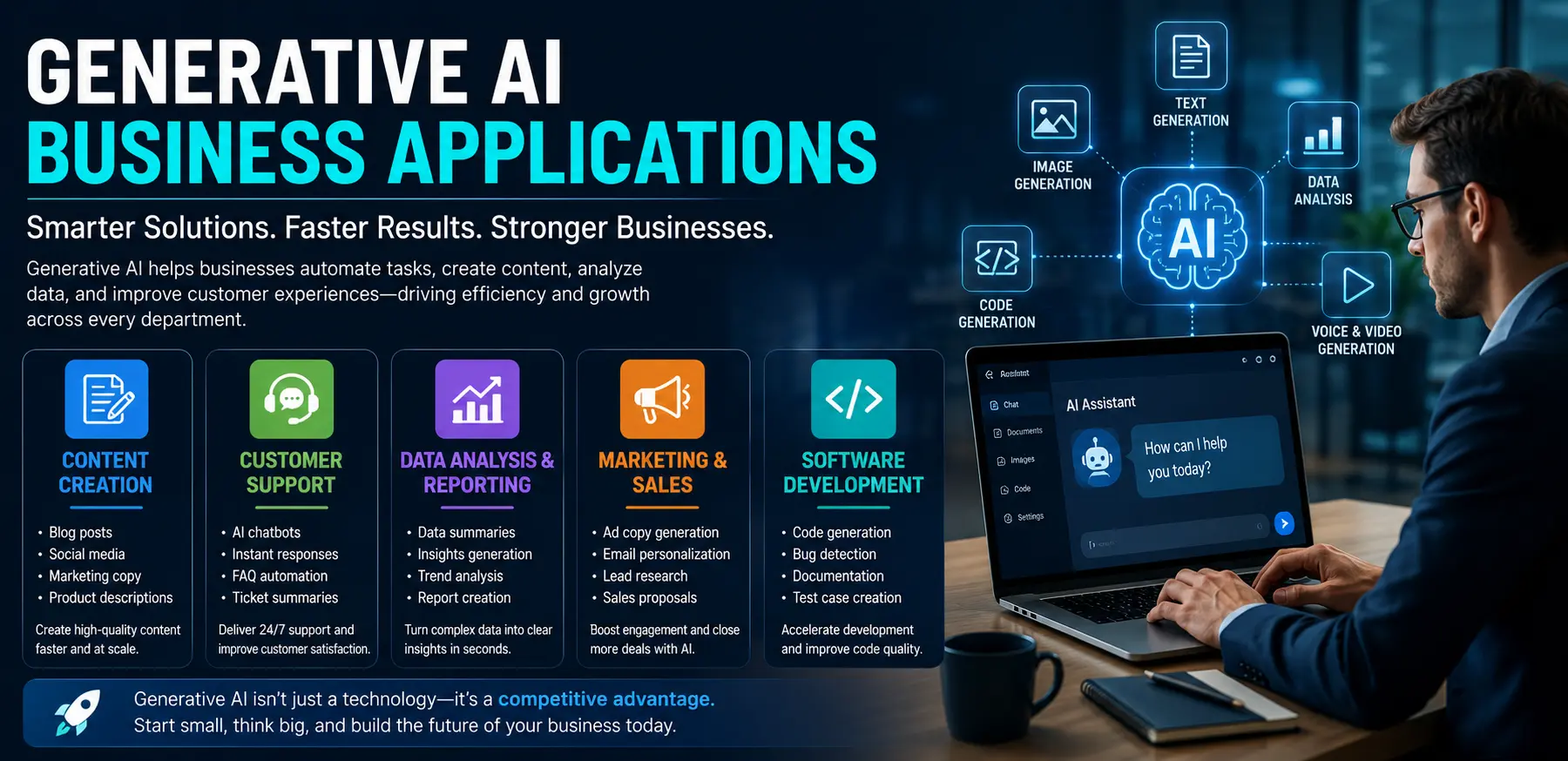
This is where Generative AI Business Applications are making a significant impact. Generative AI can create text, images, videos, code, and other forms of content based on user instructions. Instead of replacing human expertise, it helps teams work faster and focus on higher-value tasks.
From customer service and marketing to product development and data analysis, businesses across industries are discovering practical ways to use generative AI. Understanding these applications can help organizations improve productivity, save money, and remain competitive in a rapidly changing market.
Main Causes Behind the Growing Adoption of Generative AI
Increased Demand for Efficiency
Companies are under pressure to accomplish more with limited resources. Hiring additional staff is not always possible, especially for small businesses.
Generative AI helps automate content creation, research, documentation, and administrative work, allowing teams to complete tasks more quickly.
Rising Content Requirements
Modern businesses need a constant stream of content for websites, blogs, social media, email campaigns, product descriptions, and customer communication.
Creating this content manually can be expensive and time-consuming. Generative AI helps produce first drafts and creative ideas within minutes.
Customer Expectations Are Higher Than Ever
Customers expect quick responses, personalized experiences, and 24/7 support.
Businesses use generative AI to improve response times, answer common questions, and provide customized recommendations without significantly increasing staffing costs.
Rapid Growth of Business Data
Organizations collect large amounts of information from customers, sales systems, and operations.
Generative AI can analyze and summarize data, making it easier for decision-makers to understand trends and identify opportunities.
Improved Access to AI Technology
Advanced AI tools are now available through affordable cloud platforms and subscription services.
Even small businesses can access powerful AI capabilities without investing in expensive infrastructure.
Step-by-Step Solutions: Practical Generative AI Business Applications
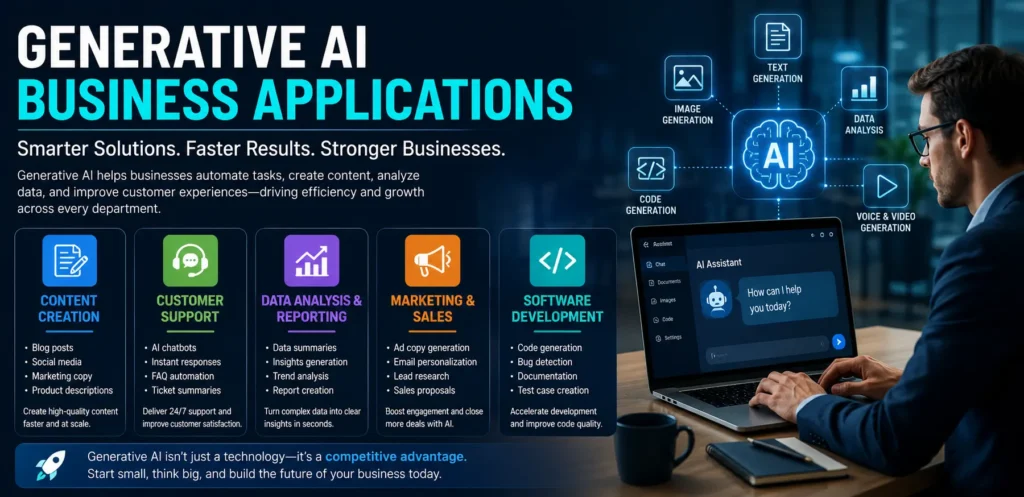
Step 1: Use AI for Content Creation
Content creation is one of the most common business applications of generative AI.
Businesses can use AI tools to create:
- Blog post drafts
- Social media content
- Product descriptions
- Email newsletters
- Marketing copy
This reduces writing time while helping teams maintain a consistent publishing schedule.
However, human review remains important to ensure accuracy, quality, and brand consistency.
Step 2: Improve Customer Support
Customer service teams often handle repetitive questions every day.
Generative AI can assist by:
- Creating chatbot responses
- Answering frequently asked questions
- Drafting customer emails
- Providing instant support suggestions
This allows support agents to focus on more complex customer issues.
Step 3: Enhance Internal Communication
Large organizations frequently spend significant time creating reports, meeting summaries, and internal documentation.
Generative AI can:
- Summarize meetings
- Generate reports
- Create training materials
- Draft internal announcements
Employees spend less time on administrative work and more time on strategic activities.
Step 4: Support Sales Teams
Sales professionals can use generative AI to improve productivity.
Examples include:
- Personalized sales emails
- Proposal creation
- Lead research
- Follow-up communication
- Sales presentation outlines
By automating routine tasks, sales teams can spend more time building relationships with potential customers.
Step 5: Accelerate Software Development
Generative AI is becoming a valuable tool for software developers.
Businesses use AI to:
- Generate code snippets
- Identify coding errors
- Create documentation
- Suggest improvements
- Speed up testing processes
Development teams can complete projects faster while maintaining quality standards.
Advanced Fixes and High-Value Generative AI Applications
Personalized Marketing at Scale
Traditional marketing often relies on broad messaging aimed at large audiences.
Generative AI allows businesses to create personalized campaigns based on customer preferences, purchasing behavior, and interests.
This can increase engagement rates and improve marketing performance.
Product Design and Innovation
Companies are using generative AI to support product development.
AI can:
- Generate design concepts
- Create prototypes
- Suggest product improvements
- Analyze customer feedback
This helps businesses bring new products to market more efficiently.
AI-Powered Knowledge Management
Organizations often struggle to organize large amounts of internal information.
Generative AI can search company databases, summarize documents, and provide employees with quick answers to business-related questions.
This improves productivity and reduces time spent searching for information.
Financial Analysis and Reporting
Finance departments can use generative AI to automate routine reporting tasks.
Applications include:
- Budget summaries
- Financial forecasts
- Performance reports
- Risk assessments
Human oversight remains essential, but AI can significantly reduce preparation time.
Employee Training and Learning
Training new employees can require substantial resources.
Generative AI can create:
- Learning materials
- Interactive training guides
- Knowledge assessments
- Personalized learning recommendations
This supports faster onboarding and continuous employee development.
Tips to Prevent Common Generative AI Challenges
Verify AI-Generated Content
AI-generated information may occasionally contain inaccuracies.
Always review important content before publishing or sharing it with customers.
Protect Sensitive Data
Avoid entering confidential business information into AI systems unless proper security measures are in place.
Data privacy should remain a top priority.
Establish Clear Usage Policies
Create guidelines that define how employees should use generative AI tools.
Clear policies reduce risks and encourage responsible adoption.
Maintain Human Oversight
Generative AI works best when combined with human expertise.
Employees should review outputs, make adjustments, and ensure business objectives are met.
Start Small Before Scaling
Instead of implementing AI across every department immediately, begin with a limited project.
Measure results, identify improvements, and expand gradually based on success.
FAQs
What are Generative AI Business Applications?
Generative AI Business Applications refer to the use of AI systems that create content, generate insights, automate workflows, and support decision-making processes within organizations.
Which industries benefit most from generative AI?
Many industries benefit from generative AI, including healthcare, finance, retail, manufacturing, education, marketing, customer service, and software development.
Can small businesses use generative AI?
Yes. Many AI tools offer affordable pricing and user-friendly interfaces, making them accessible to startups and small businesses.
Does generative AI replace employees?
Generative AI is primarily designed to assist employees rather than replace them. It automates repetitive tasks and helps workers focus on more strategic and creative responsibilities.
Is generative AI safe for business use?
Generative AI can be safe when businesses implement proper security measures, protect sensitive data, and maintain human oversight of important decisions and content.
Conclusion
Generative AI Business Applications are transforming how organizations operate. From content creation and customer support to software development and financial analysis, businesses are finding practical ways to improve efficiency and reduce manual workloads.
The most successful companies are not simply adopting AI because it is popular. They are identifying specific business challenges and using generative AI to solve real problems. This approach leads to better productivity, improved customer experiences, and stronger business performance.
As AI technology continues to evolve, organizations that combine human expertise with intelligent automation will be better positioned for long-term growth. By starting with clear goals, maintaining oversight, and focusing on practical applications, businesses can unlock the full value of generative AI while minimizing risks.
- Future of Artificial Intelligence Industry Trends Opportunities and Challenges Ahead
- Enterprise AI Solutions How Businesses Use Artificial Intelligence to Improve Efficiency and Growth
- AI Automation in the Workplace Benefits Challenges and Practical Implementation Strategies
- Generative AI Business Applications How Companies Are Using AI to Improve Productivity and Growth
- Artificial Intelligence Trends 2026 Key Innovations Shaping the Future
