
Introduction
Artificial intelligence is no longer a technology that only large tech companies use. It has become part of everyday life, helping people work faster, make better decisions, and automate repetitive tasks. From smart assistants and customer support chatbots to medical research and business analytics, AI is changing how industries operate.
As AI adoption continues to grow, many individuals and businesses are trying to understand which developments will matter most in the coming years. Keeping up with new technologies can be challenging because AI evolves quickly. Companies that fail to adapt may lose competitive advantages, while professionals who stay informed can discover new opportunities for career growth and innovation.
Understanding the most important Artificial Intelligence Trends 2026 can help businesses, entrepreneurs, students, and technology enthusiasts prepare for the future. This article explores the major trends, why they are emerging, how organizations can benefit from them, and practical ways to stay ahead.
Main Causes Driving Artificial Intelligence Trends 2026
Increased Access to AI Tools
AI platforms have become more affordable and easier to use. Many tools now offer user-friendly interfaces that allow people with little technical knowledge to build AI-powered solutions.
Cloud-based AI services have also reduced costs, making advanced technologies accessible to startups and small businesses.
Growing Demand for Automation
Organizations are constantly looking for ways to improve efficiency. AI can automate repetitive tasks such as data entry, scheduling, customer support, and document processing.
This demand for automation encourages companies to invest heavily in AI research and implementation.
Massive Growth in Data Availability
Modern businesses generate enormous amounts of data every day. AI systems require large datasets to learn and improve.
As more information becomes available through websites, mobile apps, sensors, and connected devices, AI models become more accurate and capable.
Advances in Computing Power
Powerful processors and cloud computing platforms allow AI systems to process complex tasks much faster than before.
Improved hardware enables developers to train larger models and create more sophisticated applications.
Competitive Pressure Across Industries
Businesses increasingly view AI as a necessity rather than an optional investment. Companies that successfully implement AI can reduce costs, improve customer experiences, and gain market advantages.
This competitive environment continues to push innovation forward.
Step-by-Step Guide to Understanding and Adapting to Artificial Intelligence Trends 2026
Step 1: Learn About Generative AI Expansion
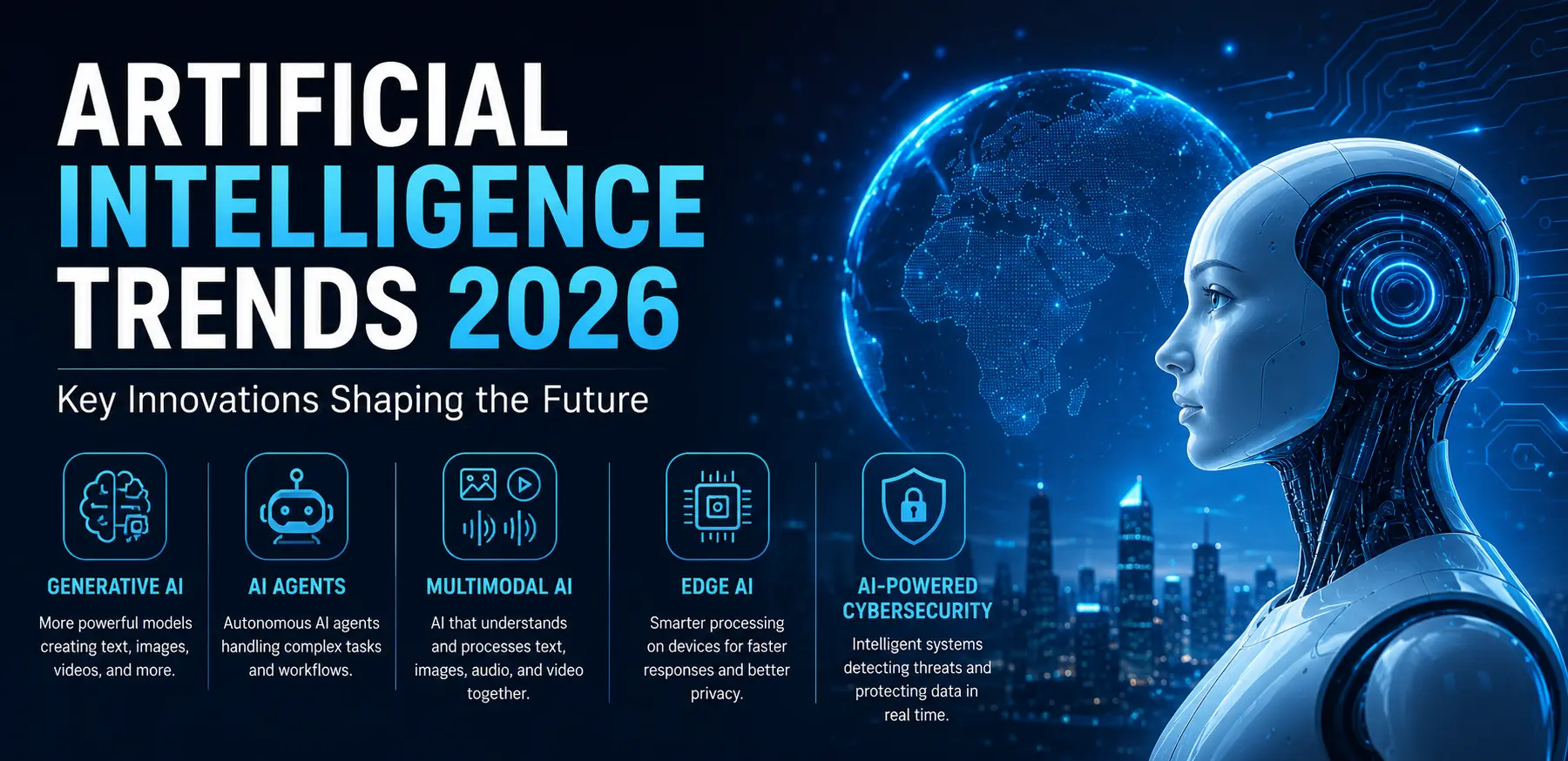
Generative AI remains one of the most influential trends in 2026.
These systems can create text, images, videos, code, and audio content. Businesses are using generative AI for marketing, customer service, product design, and content creation.
To stay updated:
- Follow trusted technology news sources
- Explore AI tools through free trials
- Learn the strengths and limitations of generated content
Step 2: Focus on AI-Powered Workplace Productivity
AI assistants are becoming standard workplace tools.
They can:
- Summarize meetings
- Draft emails
- Analyze documents
- Generate reports
- Manage schedules
Organizations should identify repetitive tasks that consume employee time and evaluate where AI can provide support.
Step 3: Monitor Industry-Specific AI Solutions
AI is becoming increasingly specialized.
Examples include:
- Healthcare diagnostic systems
- Financial risk analysis tools
- Manufacturing quality control platforms
- Retail recommendation engines
Instead of adopting generic AI solutions, businesses should focus on tools designed specifically for their industry.
Step 4: Invest in AI Skills Development
The workforce is changing rapidly.
Professionals who understand AI concepts are likely to remain competitive in the job market.
Useful skills include:
- Prompt engineering
- Data analysis
- AI ethics
- Machine learning fundamentals
- Automation workflows
Online courses and certification programs provide affordable ways to build these skills.
Step 5: Prioritize Responsible AI Usage
As AI adoption increases, concerns about privacy, fairness, and transparency become more important.
Organizations should establish guidelines for:
- Data protection
- Bias prevention
- Human oversight
- Ethical decision-making
Responsible implementation helps build trust among customers and stakeholders.
Advanced Fixes and Emerging Opportunities
Agentic AI Systems
One of the most exciting developments in Artificial Intelligence Trends 2026 is the rise of AI agents.
Unlike traditional AI tools that perform single tasks, AI agents can handle multi-step objectives independently.
For example, an AI agent may:
- Research information
- Analyze findings
- Create reports
- Schedule follow-up actions
This capability has the potential to transform knowledge-based work.
Multimodal AI Applications
Modern AI systems can process multiple forms of information simultaneously.
They can understand:
- Text
- Images
- Audio
- Video
This creates more natural interactions and enables sophisticated use cases such as visual customer support, content analysis, and accessibility tools.
Edge AI Technology
Edge AI allows processing to occur directly on devices rather than relying entirely on cloud servers.
Benefits include:
- Faster response times
- Improved privacy
- Reduced internet dependency
- Lower operational costs
Industries such as healthcare, manufacturing, and transportation are increasingly adopting edge AI solutions.
AI-Powered Cybersecurity
Cyber threats continue to evolve.
AI-based security systems can:
- Detect suspicious activity
- Monitor network behavior
- Identify vulnerabilities
- Respond to threats in real time
Businesses investing in cybersecurity AI may improve protection while reducing manual workload.
Personalized AI Experiences
Consumers increasingly expect personalized interactions.
AI can analyze user preferences and deliver customized recommendations, learning experiences, marketing campaigns, and customer support solutions.
Companies that offer personalized experiences often achieve higher customer satisfaction and retention rates.
Tips to Prevent AI Adoption Challenges
Start with Small Projects
Avoid large-scale deployments immediately.
Begin with a focused project that delivers measurable results before expanding AI usage across the organization.
Maintain Human Oversight
AI should support human decision-making rather than replace it completely.
Employees should review important outputs, especially in areas involving legal, financial, or healthcare decisions.
Keep Data Clean and Accurate
AI performance depends heavily on data quality.
Regularly update and verify datasets to ensure reliable outcomes.
Train Employees Continuously
Technology changes quickly.
Provide ongoing training to help staff understand new tools and workflows.
Monitor AI Performance Regularly
Track accuracy, efficiency, and user feedback.
Continuous monitoring helps identify weaknesses before they become major issues.
FAQs
What are the most important Artificial Intelligence Trends 2026?
Some of the most significant trends include generative AI growth, AI agents, multimodal systems, personalized AI experiences, edge computing, and AI-powered cybersecurity solutions.
Will AI replace human jobs completely?
AI is more likely to automate specific tasks rather than eliminate all jobs. Many roles will evolve, requiring workers to collaborate with AI tools and focus on higher-value activities.
Which industries will benefit most from AI in 2026?
Healthcare, finance, manufacturing, retail, education, logistics, and customer service are expected to experience substantial benefits from AI adoption.
Is AI safe for businesses to use?
AI can be safe when implemented responsibly. Organizations should prioritize data privacy, security measures, transparency, and human oversight.
How can beginners start learning AI?
Beginners can start with online courses, tutorials, free AI tools, and educational platforms that teach AI fundamentals, automation, and machine learning concepts.
Conclusion
Artificial Intelligence Trends 2026 show that AI is becoming more practical, accessible, and deeply integrated into daily operations across industries. Advances in generative AI, AI agents, multimodal systems, edge computing, and cybersecurity are creating new opportunities for businesses and individuals alike.
Success with AI is not about adopting every new technology. It is about understanding which solutions solve real problems and implementing them responsibly. Organizations that invest in AI education, ethical practices, and continuous improvement will be better positioned to benefit from future innovations.
As AI continues to evolve, staying informed and adaptable will be one of the most valuable strategies for long-term growth and success.
- Future of Artificial Intelligence Industry Trends Opportunities and Challenges Ahead
- Enterprise AI Solutions How Businesses Use Artificial Intelligence to Improve Efficiency and Growth
- AI Automation in the Workplace Benefits Challenges and Practical Implementation Strategies
- Generative AI Business Applications How Companies Are Using AI to Improve Productivity and Growth
- Artificial Intelligence Trends 2026 Key Innovations Shaping the Future
