
Introduction
Artificial intelligence is no longer limited to research labs and large technology companies. It is becoming part of everyday business operations, customer service, healthcare, education, manufacturing, and many other industries. As AI tools become more accessible, organizations are racing to adopt them, improve efficiency, and stay competitive.
The challenge is that AI evolves quickly. New models, regulations, tools, and business applications appear every year. Companies that fail to keep up may lose opportunities, while professionals who ignore emerging developments may find their skills becoming less relevant.
Understanding Artificial Intelligence Industry Trends helps businesses make smarter investments and helps individuals prepare for future career opportunities. This article explains the major trends driving the AI industry, why they matter, and how organizations can respond effectively.
Main Causes Behind Rapid AI Industry Changes
Several factors are pushing AI development forward at an unprecedented pace.
1. Increased Availability of Data
Modern businesses generate massive amounts of data from websites, mobile apps, sensors, customer interactions, and digital transactions.
AI systems rely on data to learn patterns and make predictions. As more data becomes available, AI models can become more accurate and useful across different industries.
2. Advances in Computing Power
Powerful processors and cloud computing platforms have reduced the cost of training and deploying AI models.
Organizations no longer need to build expensive infrastructure from scratch. Many can access advanced AI capabilities through cloud services and subscription-based platforms.
3. Growing Business Demand
Companies are constantly searching for ways to improve productivity, reduce costs, and enhance customer experiences.
AI helps automate repetitive tasks, analyze large datasets, and provide valuable insights. This growing demand encourages further investment and innovation.
4. Competition Among Technology Companies
Major technology firms are investing billions of dollars in AI research and development.
Competition drives rapid improvements in AI models, software tools, and enterprise solutions. As companies compete for market leadership, new features and capabilities reach users faster.
5. Government and Regulatory Involvement
Governments worldwide are creating policies to address privacy, security, transparency, and ethical concerns related to AI.
Regulations influence how organizations develop and deploy AI systems, shaping future industry standards and practices.
Step-by-Step Solutions for Keeping Up With Artificial Intelligence Industry Trends
Businesses and professionals can take practical steps to stay informed and benefit from AI advancements.
Step 1: Monitor Reliable AI News Sources
Start by following trusted industry publications, research organizations, and technology news platforms.
Regularly reading AI-related updates helps identify emerging technologies, regulatory changes, and new business opportunities before competitors.
Useful sources include:
- Research papers and journals
- Technology news websites
- Industry reports
- Official company announcements
- Government publications
Step 2: Focus on High-Impact AI Applications
Not every AI trend will be relevant to your business or career.
Instead of chasing every new development, identify areas that can create measurable value. Common examples include:
- Customer support chatbots
- Predictive analytics
- Fraud detection
- Marketing automation
- Document processing
Prioritizing practical applications often delivers better results than experimenting with every new tool.
Step 3: Invest in Employee Training
Many organizations purchase AI tools but fail to train their teams properly.
Employees should understand:
- Basic AI concepts
- Data handling practices
- AI-assisted workflows
- Ethical considerations
- Productivity tools
Training improves adoption rates and helps teams use AI more effectively.
Step 4: Build a Data Strategy
Quality data remains the foundation of successful AI implementation.
Organizations should:
- Collect relevant data
- Remove duplicate records
- Improve data accuracy
- Establish data governance policies
- Protect sensitive information
Without reliable data, even advanced AI systems may produce poor results.
Step 5: Measure Results Consistently
Track key performance indicators before and after AI implementation.
Examples include:
- Time saved
- Cost reductions
- Customer satisfaction
- Revenue growth
- Error reduction
Measuring outcomes helps determine whether an AI initiative is delivering real value.
Major Artificial Intelligence Industry Trends to Watch
Several important trends are currently shaping the AI landscape.
Generative AI Expansion
Generative AI tools can create text, images, videos, code, and audio content.
Businesses are using these systems to:
- Draft marketing materials
- Generate software code
- Create customer support responses
- Produce visual content
As accuracy improves, generative AI is becoming a standard productivity tool across many industries.
AI-Powered Automation
Organizations increasingly use AI to automate routine tasks.
Examples include:
- Invoice processing
- Appointment scheduling
- Customer inquiries
- Data entry
- Inventory management
Automation allows employees to focus on higher-value work rather than repetitive activities.
Industry-Specific AI Solutions
Instead of general-purpose tools, companies are developing AI platforms tailored to specific sectors.
Examples include:
- Healthcare diagnostic systems
- Financial risk assessment tools
- Manufacturing quality-control solutions
- Legal document analysis software
Specialized systems often deliver better results because they are designed for unique industry requirements.
Responsible and Ethical AI
Concerns about bias, transparency, privacy, and accountability continue to grow.
Organizations are investing more resources in:
- Fairness testing
- Explainable AI
- Data protection
- Compliance monitoring
- Ethical governance frameworks
Responsible AI practices are becoming essential for maintaining public trust.
AI and Cybersecurity Integration
Cyber threats are becoming more sophisticated.
AI helps security teams by:
- Detecting unusual behavior
- Identifying threats faster
- Monitoring network activity
- Reducing response times
At the same time, cybersecurity professionals must address risks created by AI-powered attacks.
Advanced Fixes for Long-Term AI Success
Organizations looking for a competitive advantage can explore deeper strategies.
Develop Internal AI Expertise
Many companies rely entirely on external vendors.
Building an internal team of AI specialists can provide greater flexibility, stronger innovation capabilities, and better long-term results.
This may include hiring:
- Data scientists
- Machine learning engineers
- AI product managers
- Data analysts
Create an AI Governance Framework
A formal governance structure helps ensure AI systems operate responsibly.
An effective framework should cover:
- Data privacy rules
- Model monitoring
- Risk management
- Regulatory compliance
- Ethical standards
Governance becomes increasingly important as AI usage expands across departments.
Combine Human Judgment With AI
AI performs best when it supports human decision-making rather than replacing it entirely.
Organizations should establish review processes for critical decisions involving:
- Hiring
- Financial approvals
- Medical recommendations
- Legal assessments
Human oversight reduces risks and improves reliability.
Experiment With Small Pilot Projects
Large-scale AI deployments can be expensive and complex.
Starting with pilot projects allows organizations to:
- Test feasibility
- Measure performance
- Identify challenges
- Gather feedback
Successful pilots can later be expanded into larger initiatives.
Tips to Prevent Common AI Adoption Problems
Many AI projects fail because organizations overlook basic planning and execution principles.
Set Clear Objectives
Define specific goals before implementing any AI solution.
For example:
- Reduce support response times by 30%
- Improve forecasting accuracy
- Lower operational costs
Clear goals improve decision-making and measurement.
Avoid Poor-Quality Data
Inaccurate data can produce misleading outputs.
Regular audits and data-cleaning processes help maintain reliability.
Keep Employees Involved
Resistance often occurs when employees fear job displacement.
Communicate how AI will support their work and provide training opportunities to encourage adoption.
Stay Updated on Regulations
AI laws and regulations continue to evolve.
Organizations should monitor legal requirements to avoid compliance issues and reputational risks.
Review AI Performance Regularly
AI systems can become less effective over time if business conditions change.
Regular monitoring ensures models remain accurate and aligned with organizational goals.
FAQs
What are Artificial Intelligence Industry Trends?
Artificial Intelligence Industry Trends are the major developments, technologies, and business practices influencing how AI is created, adopted, and used across industries.
Which industries are using AI the most?
Healthcare, finance, retail, manufacturing, logistics, education, and customer service are among the industries experiencing significant AI adoption.
Will AI replace human jobs completely?
AI is more likely to automate specific tasks rather than eliminate all jobs. Many roles will evolve, requiring workers to develop new skills and work alongside AI systems.
Why is responsible AI important?
Responsible AI helps reduce bias, improve transparency, protect privacy, and ensure technology is used ethically and safely.
How can small businesses benefit from AI?
Small businesses can use AI for customer support, marketing automation, inventory management, data analysis, and operational efficiency without investing heavily in infrastructure.
Conclusion
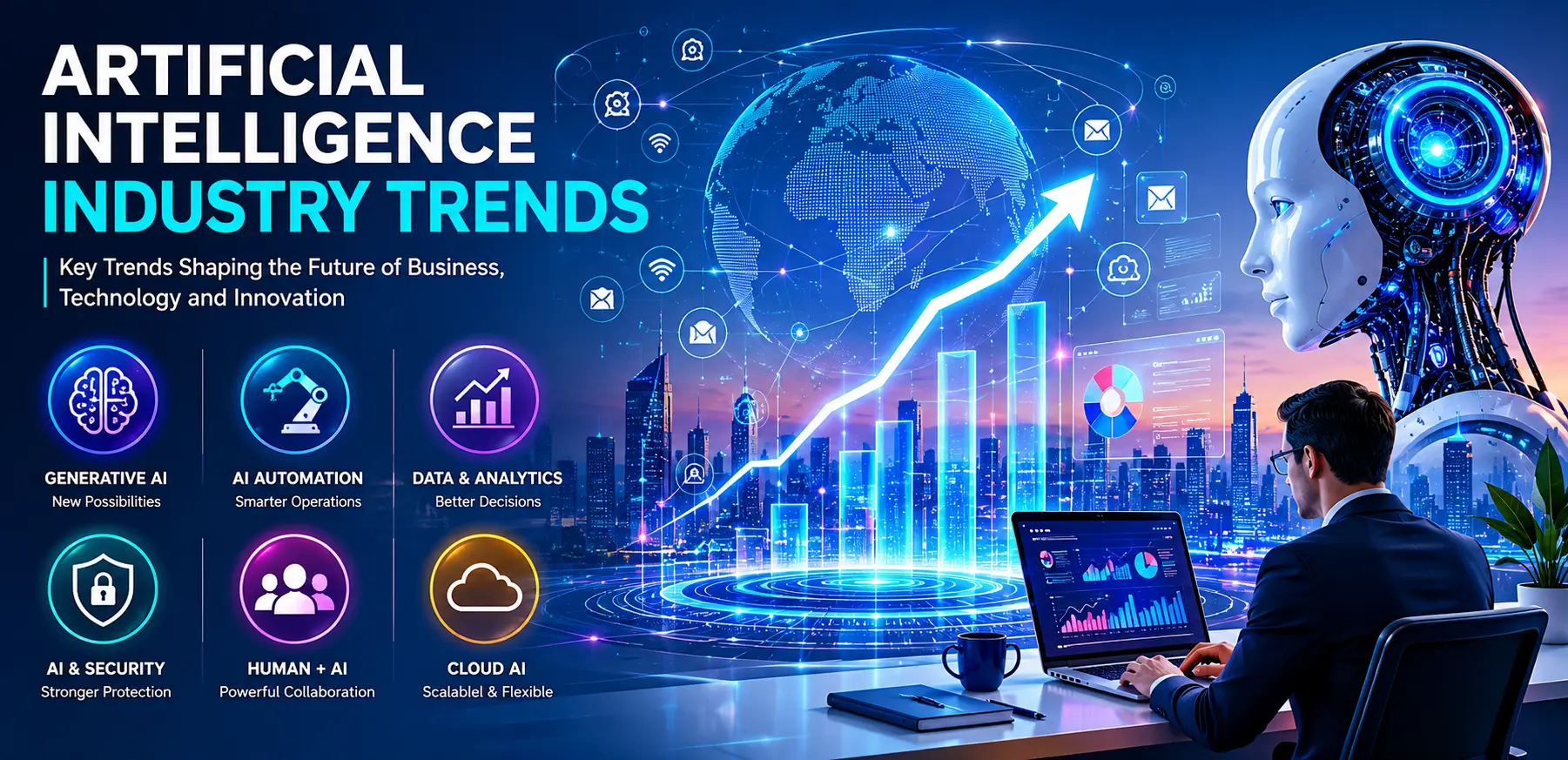
The rapid growth of AI is transforming how organizations operate, compete, and serve customers. Key Artificial Intelligence Industry Trends such as generative AI, automation, ethical governance, industry-specific solutions, and AI-powered cybersecurity are reshaping the business landscape.
Success depends on more than simply adopting new technology. Organizations must build strong data foundations, train employees, establish governance policies, and focus on measurable business outcomes. Professionals who stay informed and continue learning will be better prepared for future opportunities.
AI will continue evolving, but the organizations and individuals that adapt thoughtfully and strategically will be in the strongest position to benefit from its long-term potential.
- Future of Artificial Intelligence Industry Trends Opportunities and Challenges Ahead
- Enterprise AI Solutions How Businesses Use Artificial Intelligence to Improve Efficiency and Growth
- AI Automation in the Workplace Benefits Challenges and Practical Implementation Strategies
- Generative AI Business Applications How Companies Are Using AI to Improve Productivity and Growth
- Artificial Intelligence Trends 2026 Key Innovations Shaping the Future
