
Introduction
Large organizations manage enormous amounts of data, complex workflows, customer interactions, and operational processes every day. As businesses grow, handling these activities manually becomes increasingly difficult. Teams often face challenges such as slow decision-making, rising operational costs, inconsistent customer experiences, and inefficient use of resources.
Traditional software systems can help automate certain tasks, but they often struggle to adapt to changing business needs or process large volumes of information effectively. This creates bottlenecks that impact productivity and limit growth opportunities.
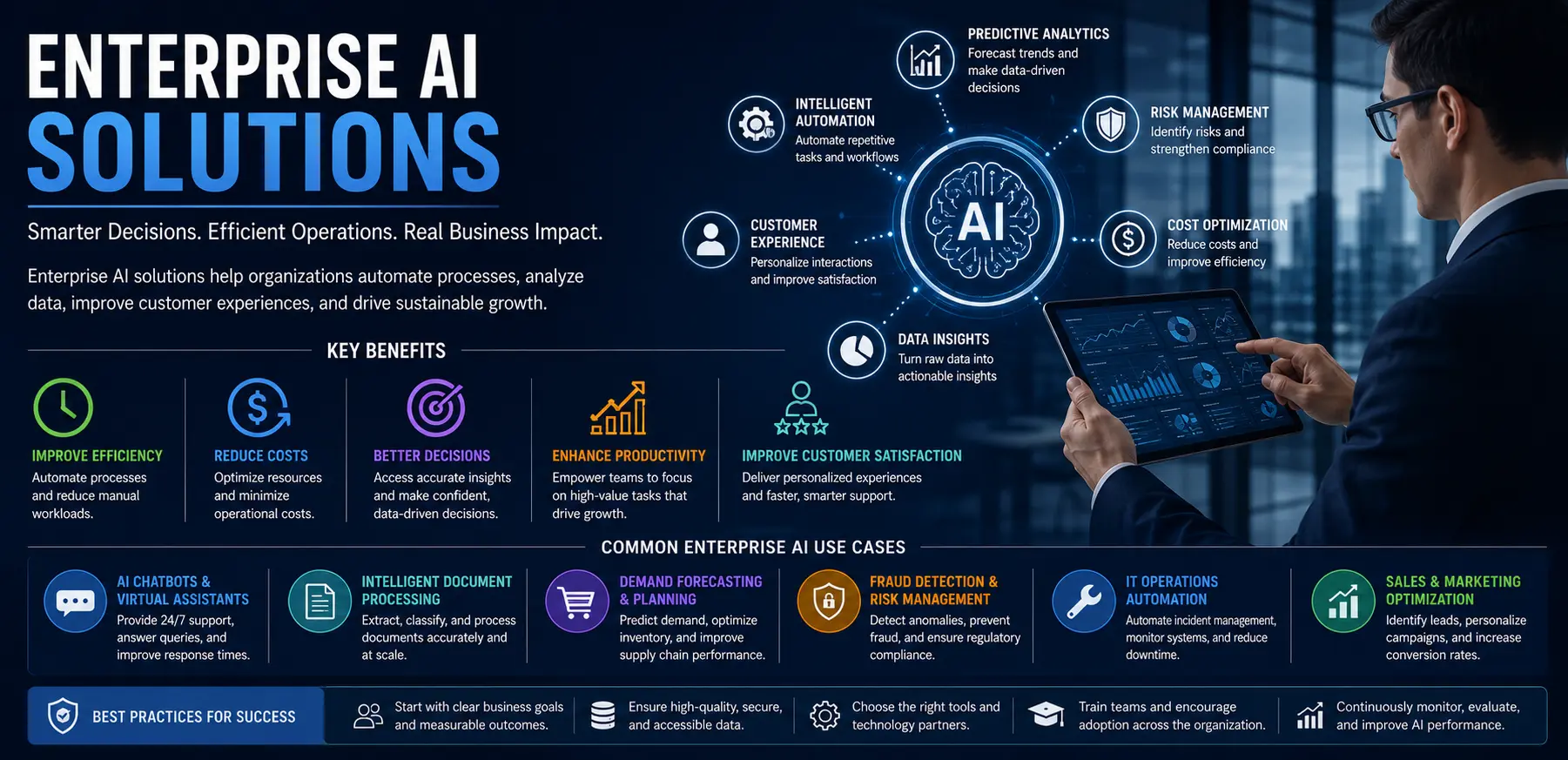
This is where Enterprise AI Solutions are making a major difference. Enterprise AI refers to artificial intelligence technologies designed specifically for large-scale business operations. These solutions can analyze data, automate workflows, improve customer service, support decision-making, and enhance overall business performance.
Organizations across industries are investing in AI to gain a competitive advantage, improve efficiency, and deliver better results. Understanding how enterprise AI works and how to implement it successfully can help businesses unlock significant value while preparing for future challenges.
Main Causes Driving the Need for Enterprise AI Solutions
Growing Volumes of Business Data
Modern organizations generate massive amounts of information from customers, employees, operations, websites, and connected devices.
Analyzing this data manually is time-consuming and often impractical. AI systems can process large datasets quickly and identify valuable insights that support business decisions.
Increasing Operational Complexity
As businesses expand, workflows become more complicated.
Multiple departments, locations, and systems must work together efficiently. Enterprise AI helps streamline operations by automating repetitive processes and improving coordination across teams.
Rising Customer Expectations
Customers expect personalized experiences, fast support, and accurate information.
Businesses use AI-powered tools to provide better service, respond more quickly, and understand customer needs more effectively.
Pressure to Reduce Costs
Organizations continually seek ways to improve efficiency without sacrificing quality.
AI can automate routine tasks, reduce manual workloads, and optimize resource allocation, leading to significant cost savings.
Competitive Market Conditions
Businesses that leverage AI often gain advantages in productivity, innovation, and customer satisfaction.
Companies that delay AI adoption may struggle to keep pace with competitors that use advanced technologies to improve performance.
Step-by-Step Solutions for Implementing Enterprise AI Solutions
Step 1: Identify Business Challenges
The most successful AI projects start by solving specific problems.
Common business challenges include:
- Slow customer support
- Manual data processing
- Inefficient workflows
- Poor forecasting accuracy
- High operational costs
Clearly defining objectives helps organizations choose the right AI solution.
Step 2: Assess Available Data
AI systems rely heavily on data quality.
Businesses should review:
- Customer information
- Operational records
- Financial data
- Sales reports
- Inventory data
Clean, accurate, and organized data improves AI performance and reliability.
Step 3: Select Appropriate AI Technologies
Different business needs require different AI solutions.
Common enterprise AI technologies include:
- Machine learning platforms
- Predictive analytics tools
- AI chatbots
- Intelligent document processing
- Natural language processing systems
- Computer vision applications
Choose technologies that align with organizational goals and existing infrastructure.
Step 4: Start with Pilot Projects
Implementing AI across an entire enterprise can be challenging.
Begin with a small project that delivers measurable results.
Examples include:
- Automating customer support requests
- Improving sales forecasting
- Streamlining invoice processing
- Automating document classification
Pilot projects allow organizations to evaluate effectiveness before scaling.
Step 5: Train Employees and Encourage Adoption
Technology alone does not guarantee success.
Employees should understand:
- How AI works
- Its benefits
- Its limitations
- Their role in AI-supported workflows
Proper training increases confidence and encourages successful adoption.
Advanced Fixes and High-Value Enterprise AI Applications
Predictive Analytics and Forecasting
One of the most valuable Enterprise AI Solutions is predictive analytics.
AI systems can analyze historical data to forecast:
- Future sales
- Customer demand
- Inventory requirements
- Market trends
- Business risks
This helps organizations make proactive decisions and reduce uncertainty.
Intelligent Process Automation
Traditional automation follows predefined rules.
AI-powered automation can adapt to changing conditions and handle more complex tasks.
Examples include:
- Processing invoices
- Managing customer requests
- Routing support tickets
- Approving routine transactions
This improves efficiency while reducing human intervention.
AI-Powered Customer Experience Platforms
Modern customers expect personalized interactions.
Enterprise AI can:
- Recommend products
- Customize marketing messages
- Provide virtual assistance
- Analyze customer sentiment
- Improve customer retention
Personalized experiences often lead to higher satisfaction and stronger loyalty.
Supply Chain Optimization
Large organizations frequently manage complex supply chains.
AI can help optimize:
- Inventory management
- Supplier performance
- Delivery schedules
- Demand forecasting
- Logistics planning
These improvements reduce costs and improve operational reliability.
AI-Driven Cybersecurity
Cybersecurity threats continue to evolve.
Enterprise AI solutions can:
- Detect unusual behavior
- Monitor network activity
- Identify security risks
- Respond to threats quickly
- Reduce false security alerts
AI strengthens organizational defenses while helping security teams operate more efficiently.
Tips to Prevent Common Enterprise AI Implementation Challenges
Focus on Clear Business Goals
Avoid adopting AI simply because competitors are doing so.
Every project should address a specific business need with measurable outcomes.
Maintain High Data Quality
Poor data often leads to poor results.
Regularly clean, update, and validate information used by AI systems.
Keep Human Oversight in Place
AI should support decision-making rather than completely replace human judgment.
Critical decisions often require human review and expertise.
Prioritize Security and Privacy
Enterprise AI systems frequently handle sensitive information.
Implement strong security controls, access management, and compliance measures to protect business data.
Measure Performance Continuously
Track key metrics such as:
- Cost savings
- Productivity improvements
- Customer satisfaction
- Error reduction
- Return on investment
Regular evaluation helps ensure long-term success.
FAQs
What are Enterprise AI Solutions?
Enterprise AI Solutions are artificial intelligence technologies designed to help large organizations automate processes, analyze data, improve decision-making, and enhance operational efficiency.
Which industries use enterprise AI?
Enterprise AI is widely used in healthcare, finance, retail, manufacturing, logistics, telecommunications, education, and many other industries.
Are Enterprise AI Solutions only for large corporations?
While originally designed for large organizations, many enterprise AI tools are now available to medium-sized businesses through cloud-based platforms and subscription services.
How long does AI implementation take?
Implementation timelines vary depending on project complexity. Small pilot projects may take a few weeks, while enterprise-wide deployments can take several months or longer.
Is enterprise AI expensive?
Costs depend on the scope of the project, technology requirements, and implementation strategy. Many organizations begin with small projects to demonstrate value before making larger investments.
Conclusion
Enterprise AI Solutions are transforming how organizations manage operations, serve customers, and make strategic decisions. By leveraging artificial intelligence, businesses can automate repetitive tasks, gain deeper insights from data, improve forecasting accuracy, and enhance customer experiences.
Successful AI adoption begins with identifying clear business objectives, ensuring data quality, selecting appropriate technologies, and supporting employees throughout the implementation process. Organizations that approach AI strategically are more likely to achieve measurable benefits and long-term success.
As artificial intelligence continues to evolve, businesses that invest in responsible and practical AI solutions will be better equipped to adapt to changing market demands, improve efficiency, and maintain a competitive advantage in the years ahead.
- Future of Artificial Intelligence Industry Trends Opportunities and Challenges Ahead
- Enterprise AI Solutions How Businesses Use Artificial Intelligence to Improve Efficiency and Growth
- AI Automation in the Workplace Benefits Challenges and Practical Implementation Strategies
- Generative AI Business Applications How Companies Are Using AI to Improve Productivity and Growth
- Artificial Intelligence Trends 2026 Key Innovations Shaping the Future
