
Introduction
Artificial intelligence has rapidly evolved from a specialized technology into a powerful tool used across nearly every industry. Businesses use AI to automate tasks, improve customer experiences, analyze data, and make smarter decisions. Individuals interact with AI through virtual assistants, recommendation systems, smart devices, and online services every day.
Despite these advancements, many people remain uncertain about the future direction of the AI industry. Questions about job displacement, ethical concerns, regulation, data privacy, and technological limitations continue to shape discussions around artificial intelligence. At the same time, organizations are investing billions of dollars into AI research and development, making it one of the fastest-growing sectors in the global economy.
Understanding the Future of Artificial Intelligence Industry is important for businesses, professionals, students, and policymakers. Those who prepare for upcoming changes will be better positioned to take advantage of new opportunities while addressing potential challenges. This article explores the key factors driving AI growth, practical ways to adapt, emerging innovations, and strategies for responsible adoption.
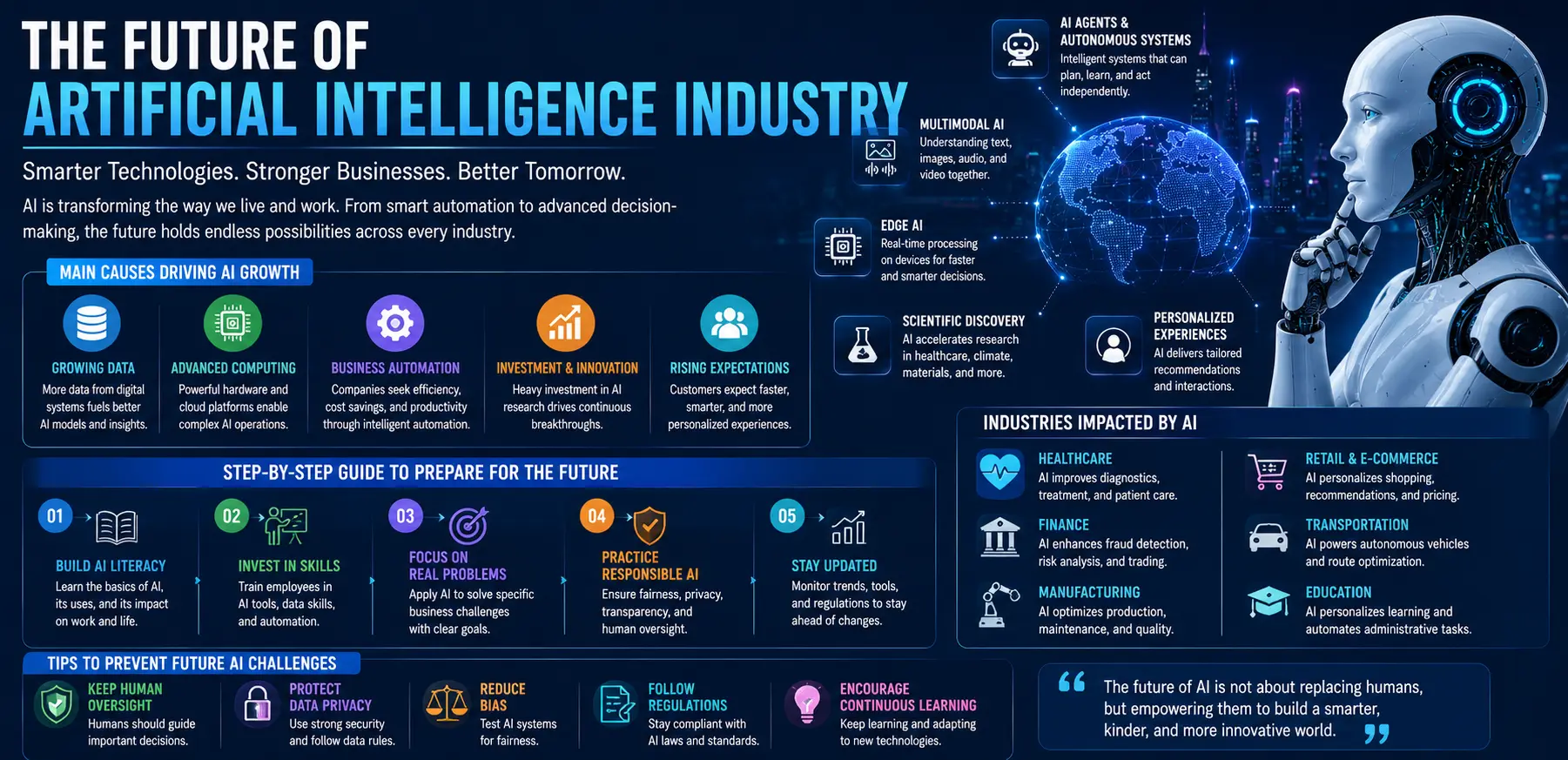
Main Causes Driving the Future of Artificial Intelligence Industry
Rapid Growth of Data
Every day, businesses and consumers generate enormous amounts of information through websites, mobile applications, social media, online transactions, and connected devices.
AI systems rely on large datasets to learn patterns and improve performance. As data volumes continue to increase, AI technologies become more capable and valuable across industries.
Advances in Computing Power
Modern processors, cloud infrastructure, and specialized AI hardware have dramatically improved computing capabilities.
These advancements allow AI models to process complex tasks faster and more efficiently, making large-scale AI adoption possible.
Demand for Business Automation
Organizations constantly seek ways to improve efficiency and reduce operational costs.
AI-powered automation helps businesses streamline repetitive tasks, improve accuracy, and increase productivity, making automation a major driver of industry growth.
Increasing Investment in AI Research
Governments, technology companies, startups, and research institutions continue to invest heavily in AI development.
This ongoing investment accelerates innovation and expands the range of practical AI applications available to businesses and consumers.
Growing Consumer Expectations
People increasingly expect personalized experiences, instant support, and intelligent digital services.
AI enables companies to meet these expectations through recommendation systems, virtual assistants, customer support automation, and predictive services.
Step-by-Step Solutions for Preparing for the Future of Artificial Intelligence Industry
Step 1: Develop AI Literacy
Understanding basic AI concepts is becoming increasingly important across professions.
Individuals should learn:
- How AI works
- Common AI applications
- Benefits and limitations
- Ethical considerations
Basic AI knowledge helps professionals remain competitive in a changing job market.
Step 2: Invest in Workforce Training
Businesses should prioritize employee education and skills development.
Key areas include:
- Data analysis
- AI-assisted workflows
- Automation tools
- Prompt engineering
- Digital literacy
Training programs help employees adapt to new technologies rather than fear them.
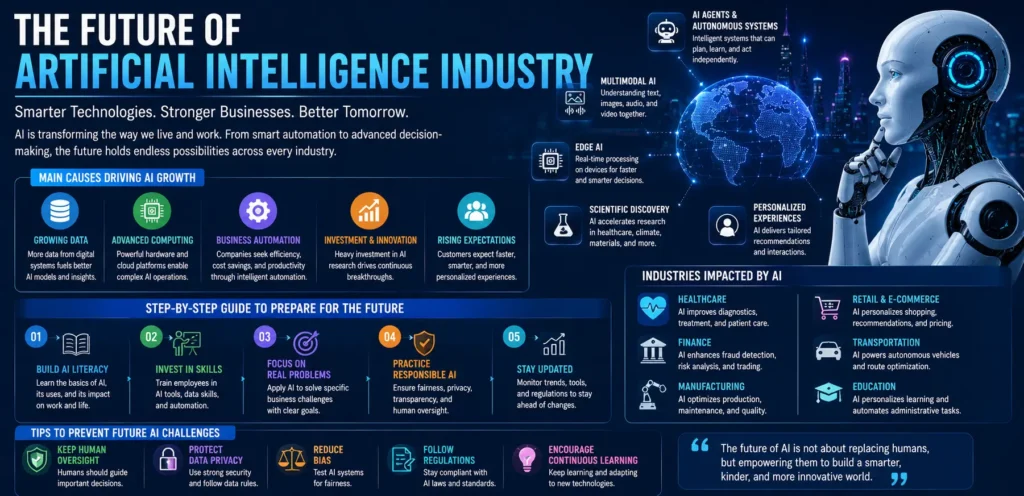
Future of Artificial Intelligence Industry Trends Opportunities and Challenges Ahead
Step 3: Identify Industry-Specific Opportunities
Different industries will experience AI adoption in unique ways.
Examples include:
- Healthcare diagnostics
- Financial risk analysis
- Manufacturing automation
- Retail personalization
- Logistics optimization
Organizations should focus on applications that solve real business challenges.
Step 4: Implement Responsible AI Practices
As AI becomes more powerful, responsible use becomes increasingly important.
Businesses should establish policies regarding:
- Data privacy
- Transparency
- Fairness
- Accountability
- Human oversight
Responsible AI builds trust among customers, employees, and stakeholders.
Step 5: Monitor Emerging Technologies
The AI industry evolves rapidly.
Businesses and professionals should stay informed about:
- New AI models
- Regulatory developments
- Industry standards
- Technological breakthroughs
Continuous learning helps organizations remain adaptable and competitive.
Advanced Fixes and Emerging Opportunities
AI Agents and Autonomous Systems
One of the most significant developments shaping the Future of Artificial Intelligence Industry is the rise of AI agents.
Unlike traditional AI systems that perform single tasks, AI agents can complete complex objectives by combining multiple actions independently.
For example, an AI agent may:
- Gather information
- Analyze data
- Generate reports
- Communicate findings
- Schedule follow-up actions
These capabilities could transform many business functions.
Multimodal Artificial Intelligence
Future AI systems will increasingly process multiple forms of information simultaneously.
They will understand:
- Text
- Images
- Audio
- Video
- Sensor data
This creates more natural interactions and enables advanced applications across healthcare, education, security, and customer service.
Personalized AI Experiences
AI systems are becoming better at understanding individual preferences.
Future applications may provide highly personalized:
- Learning experiences
- Healthcare recommendations
- Shopping suggestions
- Financial guidance
- Entertainment content
Personalization is expected to become a major competitive advantage for businesses.
AI and Scientific Discovery
Researchers are increasingly using AI to accelerate scientific breakthroughs.
Applications include:
- Drug development
- Climate modeling
- Material science
- Medical research
- Energy optimization
AI has the potential to significantly reduce research timelines and improve innovation.
Edge AI and Real-Time Processing
Future AI systems will perform more processing directly on devices rather than relying entirely on cloud infrastructure.
Benefits include:
- Faster performance
- Improved privacy
- Reduced latency
- Greater reliability
Edge AI is expected to play a major role in autonomous vehicles, smart devices, and industrial automation.
Tips to Prevent Future AI Challenges
Maintain Human Oversight
AI systems should support human decision-making rather than operate without accountability.
Human review remains essential for important decisions involving health, finance, legal matters, and public safety.
Prioritize Data Security
As AI adoption grows, organizations must protect sensitive information.
Strong cybersecurity measures help reduce risks associated with data breaches and misuse.
Address Bias in AI Systems
AI models can reflect biases present in training data.
Organizations should regularly evaluate systems to ensure fairness and accuracy.
Adapt to Regulatory Changes
Governments around the world are developing AI regulations.
Businesses should stay informed about legal requirements and compliance obligations.
Encourage Continuous Learning
Technology evolves rapidly.
Employees, leaders, and organizations should commit to ongoing education to remain prepared for future developments.
FAQs
What is the Future of Artificial Intelligence Industry?
The Future of Artificial Intelligence Industry refers to the ongoing growth and development of AI technologies, including automation, machine learning, AI agents, personalized systems, and industry-specific applications that will shape businesses and society in the coming years.
Which industries will benefit most from AI in the future?
Healthcare, finance, manufacturing, retail, transportation, logistics, education, and cybersecurity are expected to experience significant benefits from continued AI advancement.
Will artificial intelligence replace human jobs?
AI is more likely to automate specific tasks rather than eliminate all jobs. Many roles will evolve, requiring workers to collaborate with AI systems and focus on strategic, creative, and interpersonal responsibilities.
Is AI safe for long-term use?
AI can be used safely when organizations implement responsible practices, maintain human oversight, protect data privacy, and address ethical concerns.
How can beginners prepare for the future of AI?
Beginners can start by learning AI fundamentals, exploring practical AI tools, developing digital skills, and staying informed about industry trends and technological advancements.
Conclusion
The Future of Artificial Intelligence Industry is filled with opportunities for innovation, productivity, and economic growth. Advances in AI agents, automation, multimodal systems, personalized experiences, and scientific research are expected to transform how businesses operate and how people interact with technology.
Success in this evolving landscape will depend on more than simply adopting new tools. Organizations and individuals must focus on education, responsible implementation, ethical practices, and continuous learning. Those who prepare today will be better equipped to benefit from future advancements while navigating the challenges that accompany technological change.
As artificial intelligence continues to mature, its impact will extend across nearly every aspect of society, making it one of the most important industries to watch in the years ahead.
- Future of Artificial Intelligence Industry Trends Opportunities and Challenges Ahead
- Enterprise AI Solutions How Businesses Use Artificial Intelligence to Improve Efficiency and Growth
- AI Automation in the Workplace Benefits Challenges and Practical Implementation Strategies
- Generative AI Business Applications How Companies Are Using AI to Improve Productivity and Growth
- Artificial Intelligence Trends 2026 Key Innovations Shaping the Future
